How Three Alumnae at World Without Exploitation Brought Sex Trafficking Out of the Shadows

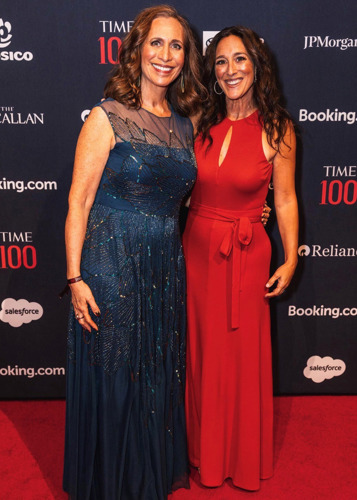
World Without Exploitation cofounders, President Rachel Foster '94 and CEO Lauren Hersh '02, who work alongside a third alumnae, Policy Director Rebecca Zipkin '11 gained national attention for their work with the Epstein survivors.
The public service announcement video opening was striking and effective: A series of women held up photos of themselves as teenagers and said, "This is me when I met Jeffrey Epstein." The closing text encouraged viewers to ask their local Congress members to release the Epstein files.
World Without Exploitation (WorldWE), an anti-sex-trafficking coalition led by three Brooklyn Law School alumnae, created the PSA, which ran on a Monday Night Football broadcast and, along with a second video, reached 200 million households and intensified public attention around efforts to unseal and release Epstein-related records. The coalition’s co-founders, President Rachel Foster '94 and CEO Lauren Hersh '02, were named in April to the TIME 100 list of the world’s most influential people for their pioneering work for the Epstein victims, which spans policy and legislative advocacy, survivor organizing, and public awareness campaigns. The two extend credit to a third alum, Rebecca Zipkin '11, the group’s policy director, and a powerhouse in advocating for New York State sex crime victims.
'They Fought for Change and Made it Happen'
The team’s work on the Epstein case began with a U.S. Capitol rally they organized where 25 Epstein survivors along with other sex trafficking survivors and allies met for the first time in September 2025.
"It was this incredible moment of sisterhood, of not being alone, and that power and force of being part of a collective voice," Foster recalled. "They became this united force of activism."
Two months later, they planned to meet on Capitol Hill with the U.S. House of Representatives’ Democratic and Republican Women’s Caucuses, separately, to lobby for the Epstein Files Transparency Act, but a schedule change led to one lunch with both groups just before the vote. This forged the united front the survivors and their advocates hoped for. "Our message has been clear, consistently: For us and for the survivors, this is not about politics. This is deeply personal," Foster said.
"We all walked into the vote together, which was very, very powerful," Hersh said. "And the survivors felt like, 'This is not left. This is not right.' They just felt really loved and supported."
The bill passed the House almost unanimously and later cleared the Senate before being signed by the president. WorldWE’s role in all of this was recognized by lawmakers. "They have fought for change and made it happen with the release of the files," U.S. Rep. Pramila Jayapal wrote in the Time100 tribute. "Taken together, this network continues to expose the depravity of what these women endured, and to demand accountability from a society that has closed its eyes to the horrors for far too long."
Connecting the Dots
Although Foster and Hersh launched WorldWE a decade ago and Zipkin joined in 2020, all three first pursued their public service passions at Brooklyn Law School.
Foster was part of the Edward V. Sparer Public Interest Law Fellowship Program, which celebrated its 40th anniversary this year. In addition, she enrolled in the Federal Litigation clinic and started a battered women’s hotline. After graduation, she joined South Brooklyn Legal Services and managed civil cases for mainly HIV-positive clients facing issues related to health and housing. Foster later came to believe some of the clients may have been sex trafficking victims. "They were exactly the population that draws sex-trafficking predators who want to ensnare them into these incredibly harmful systems," Foster said.
At BLS, Hersh recalled working with domestic violence victims in a Civil Law clinic one summer. She learned about sex trafficking while serving as a domestic violence prosecutor at the Kings County District Attorney’s Office, then lobbied to create a sex trafficking unit and became its first chief. While many associate sex-trafficking with foreign nations, Hersh and Foster discovered it was quietly affecting Americans on society’s margins, including the poor, women and girls of color, and LGBTQ+ youth.
"Nobody was connecting the dots," Hersh said. "The vast majority of victims that I intersected with were American-born women and girls. Most were extraordinarily vulnerable in many ways, situated at the intersection of racial, gender, and income inequality."
Launching WorldWE
Hersh first met Zipkin through longtime former Brooklyn Law School Professor Lisa Smith, who is Zipkin’s mother and Hersh’s mentor. After Zipkin enrolled at BLS, she wrote a paper on sex trafficking for the Brooklyn Journal of International Law and interviewed Hersh, who had become her mentor. They both worked first at the Brooklyn D.A.’s office and then Sanctuary for Families.
"After I first joined Kings County DA’s office, I requested to go to the special victims’ unit right away," Zipkin said. "I really wanted to understand how the systems worked before I ever did policy or advocacy work, but I always knew that was where my heart was and what I really wanted to be doing."
At Sanctuary for Families, she worked on changing New York State law so that children who were victims of sex trafficking would no longer have to testify as to how they were victims of force, fraud, or coercion. Prior to 2017, only the states of New York and Alabama forced minors to testify.
Hersh and Foster, who first worked on Sanctuary for Families projects together 13 years ago, decided to launch WorldWE in 2016 to help unify the groups working on behalf of sex-trafficking survivors.
"There was a lot of really good work happening in the space, but most of the organizations were overworked and under-resourced. So, in these critical moments where we wanted to make significant legislative change or shift policy there was not an entity to bring the organizations together," Hersh said.
They created that entity, but after a time, knew they needed someone who was deeply versed in policy work. "There was only one person that we'd worked with who had really, really serious policy chops that came from the place of understanding how legislation translates back into on the ground, and that was Becca (Zipkin)," Hersh said.
Zipkin’s most recent victory came in June 2026, when the New York State Legislature passed into law a bill she had first conceived called the Victim Protection and Child Sex Buyer Accountability Act. It is now a felony, not a misdemeanor, to solicit sex from someone between the ages of 15 and 17, strengthening what Zipkin says are surprisingly weak sex trafficking laws in the state.
"It was a really significant win," said Foster. Added Hersh: "It was a very heavy lift from a strategy perspective and just a huge victory that Becca literally pushed the boulder up the mountain."
Today, WorldWE, which started out with five member organizations, is the umbrella group for 200 organizations, serving as the policy, education, and advocacy arm. Many of the groups are led by sex-trafficking survivors, and some are graduates of the organization’s STAND program, a one-year training and mentorship opportunity for sex trade and sex trafficking survivors who can apply for six spots annually.
"A critical part of who we are as an organization is the survivor leadership, the youth activism policy work, and not only legal change and policy change, but cultural change," Foster said.
Getting to Truth and Transparency
The Epstein-related work is far from over. WorldWE is now working on two more initiatives: One is Virginia’s Law, named after Epstein abuse survivor Virginia Roberts Giuffre, which would extend the federal civil statute of limitations beyond 10 years to allow survivors victimized more than a decade ago to sue their abusers.
The second is the Redact Act, which would allow survivors to sue the federal government for failing to protect private information in the release of the Epstein files. Some of the released files shared the names and even nude photos of the victims, Hersh said, while other files over-redacted the names of those who exploited the women.
"We've been really working hard with the survivors since the files have begun being released to make sure that we get to truth, transparency, and ultimately accountability for all of the powerful people that have caused tremendous harm," she added.
It took 10 years for WorldWE to help pass the 2025 Trafficking Survivors Relief Act, which nullifies past criminal convictions for those who committed crimes while victims of sex trafficking. The Epstein files work is about holding perpetrators to account.
"We want to make sure that those who've been exploited in the sex trade are not criminalized ever for the harm that's happened to them and that they get the exit strategies and services they need to exit," Hersh said. "But at the same time, we want to make sure that those who exploit them — the pimps, the sex buyers, the brothel owners — are held accountable for the devastating harm they cause."