Professors Stacy Caplow and Maryellen Fullerton Combine Immigration Law and Literature in Unique Seminar Class

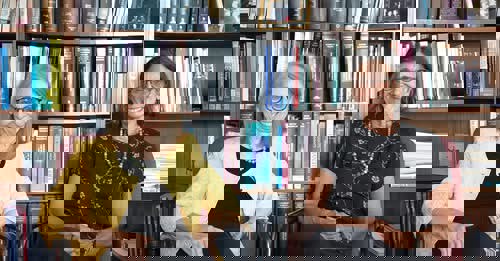
Students take part in a lively discussion during the 2-credit seminar class, “Law and Literature: The Immigration Experience,” which Professors Stacy Caplow and Maryellen Fullerton have taught for the past decade. Here, students engage in the final class of the Fall 2025 semester.
What do books and movies such as Brooklyn, The Godfather II, or The Namesake have to do with becoming a lawyer? For students taking part in “Law and Literature: The Immigration Experience,” the answer is much more than you might think.
The 2-credit seminar class was created by two longtime professors who have taught immigration law to generations of students: Professor Stacy Caplow, who led the Law School’s Clinics program for decades, and co-directs the Safe Harbor Project; and Suzanne J. and Norman Miles Professor of Law Maryellen Fullerton, a former interim dean and prolific scholar who writes and speaks internationally about asylum and refugee law.
First introduced a decade ago, the course was offered for the third year in a row this fall. “Our hypothesis for the course is that lawyers need to tell stories in whatever they do, whether it's an affidavit or a deposition or at trial, and they also need to tell stories when negotiating,” Fullerton said. “We wanted to build in the whole notion of narrative and storytelling as being crucial to what lawyers do, but to also explore it in this literary framework.”
“You need imagination to take this class,” Caplow said. “It’s going to help students become more thoughtful about the ways in which storytelling and narrative are helpful to lawyers.”
Literature and The Law
In Literature and Law classes at Brooklyn Law and other schools, students often read classics such as Fyodor Dostoevsky’s Crime and Punishment or The Trial by Franz Kafka. This class stands apart for focusing on immigration law, the immigrant experience, and how the zeitgeist of different time periods affects both. It feels particularly timely now, with the Trump administration’s restrictive approach, and the students are very engaged with the parallels and contrasts with earlier times.
“We aren’t really looking at the philosophy of crime and punishment. We are looking at how the philosophy and politics changed over immigration throughout the nation's history and how that got reflected in fiction and nonfiction,” Fullerton said. In class discussions, students are prompted to answer questions such as “Who is the intended audience for the book?” and "How long after the events took place were the books written?”
The required books include Becoming Americans, edited by Ilan Stavans, featuring first-person and fictional accounts of U.S. immigrants; Immigration Stories, compiled by David Martin and Peter Schuck, which examines the backstories of well-known immigration cases that reached the U.S. Supreme Court; and the Penguin Book of Migration Literature, edited by Dohra Ahmad, an anthology of literature about different facets of the migration experience.
For each class, the required readings included both legal materials and literary works. For example, for one class the students might read Chae Chan Ping v. U.S. (1889), the infamous Chinese Exclusion case, the Immigration Stories chapter setting out the history of the litigation and the anti-Chinese legislation enacted by Congress, poems by Chinese immigrants, and Maxine Hong Kingston’s story The Grandfather of the Sierra Nevada Mountains. Throughout the semester, the assigned literature included characters who immigrated from different continents and during different time periods.
Students also read and analyzed current immigration articles in periodicals such as the New Yorker, and watched Human Flow, a film about the global immigration crisis by Chinese artist and activist Ai Weiwei.
Op-Eds and Children’s Books
In addition to reading short stories, memoirs, poems, and essays, the students completed a wide range of writing assignments.
“Students need a lot of experience writing for different audiences. From the beginning, we had the idea that, as part of this course, students would not only be reading interesting works of literature, but producing different types of writing, sometimes two pages, sometimes five pages,” Fullerton said.
As students learned about the historical timeline of U.S. immigration laws, they had to interview a family member and write that person’s immigration story, placing it in the context of the general immigration law in force at the time of immigration. Students later turned those stories into short works of fiction.
In another assignment, students wrote an op-ed for a non-legal audience about a contemporary topic related to immigration. Yet another assignment required students to write an affidavit on behalf of a fictional 20-year-old Ugandan woman seeking asylum. In addition, after an author who writes for children and young adult readers visited the class, the students worked in groups to create their own children’s books. At the end of the semester, students also drafted a five- to seven-page paper on a novel of their choosing.
Film as Literature
For the final class, students read works that have been made into films and then watched excerpts of the films. They saw the opening moments of The Godfather II, where Vito Corleone had to flee for his life from the grinding poverty and stratified society of Sicily. Students were eager to discuss the contrasts between the books and the visually rich scenes in the movies they inspired. They emphasized how the vibrant score in The Godfather II informed viewers of “how to feel in the moment,” and they commented on many of the reasons that parents often “don’t tell their children the full story” behind their immigration experiences.
Students also had read the first chapter of The Namesake by Jhumpa Lahiri, a story in which a woman in an arranged marriage left Kolkata (Calcutta) and moved with her husband to New York City, where she must adjust to a new world and an entirely different culture. In the movie version, directed by Mira Nair, one student commented on how effectively the film depicted the female character’s power in the scene where she tried on her soon-to-be husband’s shoes. Others pointed out that the family members switched between English and their native Bengali, symbolic of the way they kept one foot in their native land while navigating their new home.
Legacies
Reflecting on the semester’s assignments, Caplow was particularly impressed with the creative work that students did in creating children’s books related to immigration. Fullerton focused on the assigned chapters concerning the individual immigrants who brought their cases to the Supreme Court.
“These readings revealed the power of storytelling, even in the legal context,” Fullerton said. “When you look at what the Supreme Court left out of their opinion, you can see how they were shaping the story. You can see what they ignored, or things that they may have slightly misrepresented.”
Although Caplow and Fullerton are both retiring this school year, after teaching at Brooklyn Law School for 50 and 45 years, respectively, students may try to entice them back on campus to teach this class about law and creativity once again.
“It's not traditional but it is great fun for us,” Caplow said. “We can take time to do some really enjoyable reading and mix in the appropriate historical and legal context. It's kind of a mixed-media class.”